Designing a Human-Centered Beauty Assistant
From Research to Chatbot: explored how we could translate user needs into a personalised, trustworthy digital assistant—one that doesn’t just recommend products, but truly understands people.
Resources
~ 3 minutes

The Problem: Too Many Choices, Too Little Trust
The research revealed a clear gap in the beauty ecosystem.
Users weren’t struggling because of a lack of products. They were struggling because of:
Lack of guidance in choosing the right products
Low trust in automated or sales-driven recommendations
A growing need for holistic solutions combining beauty and wellness
Many users preferred consulting dermatologists or trusted individuals over relying on digital tools.
This raised a key question:
How might we make technology feel more human, trustworthy, and intuitive?

Rethinking the Role of a Beauty Chatbot
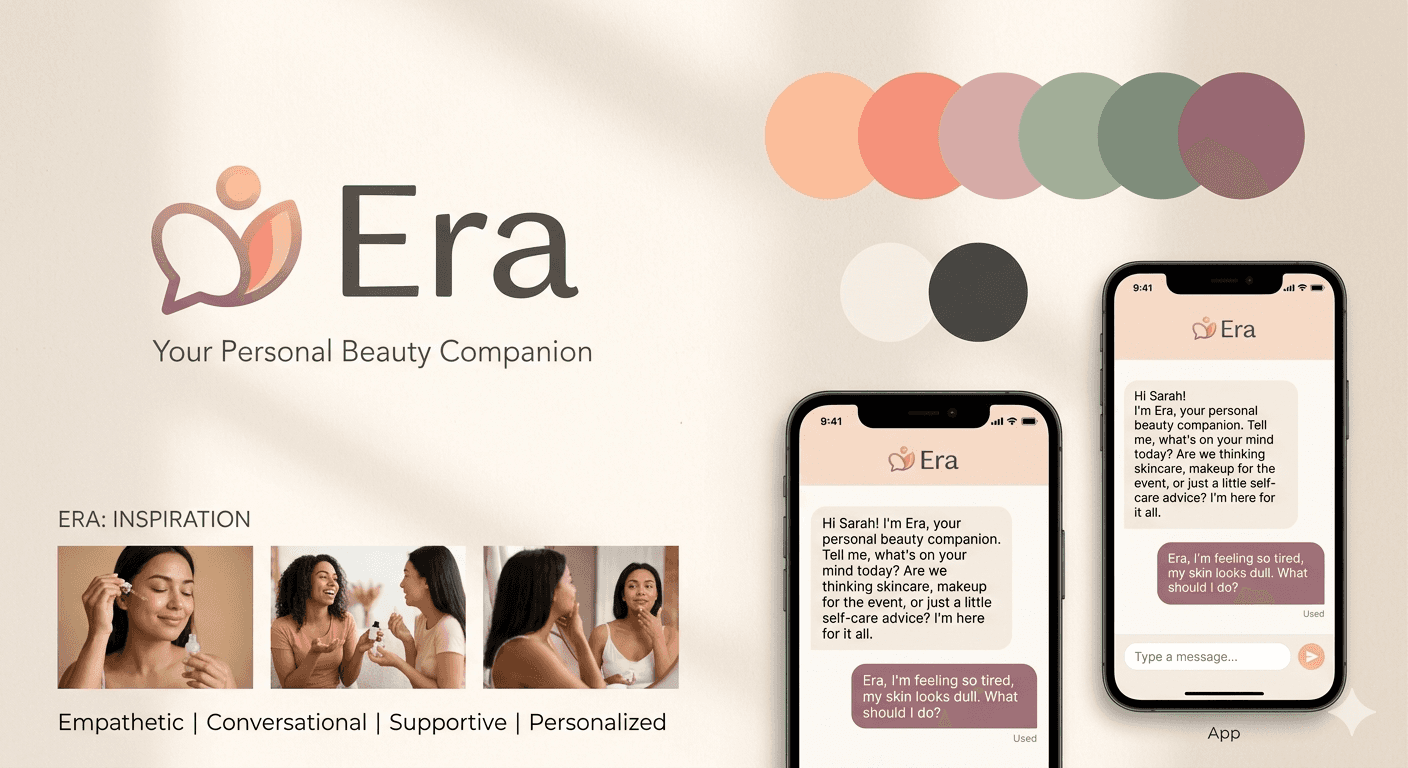
Instead of building a typical recommendation engine, the idea was to design a beauty assistant that behaves like a companion.
The goal was to move away from systems that feel:
Robotic
Predictable
Transactional
And instead create something that feels:
Empathetic and conversational
Personalised to individual needs and lifestyles
Supportive, like a friend or expert
This led to the concept of Era—an intelligent, human-like beauty assistant.
Designing for Trust and Personalisation
Trust became the foundation of the entire experience.
To build credibility, the assistant was designed to:
Combine product recommendations with dermatologist inputs
Provide transparent ingredient-level insights
Adapt to user lifestyle factors like sleep, stress, and environment
Offer users control and choice, instead of pushing decisions
Rather than replacing experts, the system bridges the gap between users and professionals.
From Conversations to Real-World Actions
The chatbot was not just about answering questions—it was about enabling action.
Use Case 1: Solving Skin Concerns
A user experiencing a skin issue could:
Identify possible causes (e.g., ingredients)
Receive safer product alternatives
Choose to consult a dermatologist directly
Get follow-ups on progress
Use Case 2: Guided Discovery
For users unfamiliar with beauty products:
The assistant helps explore looks, products, or services
Recommends options based on preferences and constraints
Even assists in booking in-store appointments to try products
This creates a seamless bridge between digital guidance and physical experience.
Design Principles That Shaped the Experience
A few key principles guided the chatbot design:
Human over automated → Conversations feel natural, not scripted
Guidance over recommendation → Help users decide, don’t decide for them
Transparency over persuasion → Build trust through clarity
Flexibility over linear flows → Adapt to different user journeys
The aim was to design a system that evolves with the user rather than forcing them into predefined paths.
Beyond a Chatbot: A Connected Beauty Ecosystem
This concept expanded beyond a simple chat interface into a broader platform that:
Connects users with dermatologists and experts
Tracks lifestyle and product effectiveness
Enables experimentation both online and in-store
Supports long-term beauty and wellness journeys
It reimagines beauty not as a one-time purchase, but as an ongoing, personalised experience.
Key Takeaway: Technology Needs a Human Touch
This project reinforced an important insight:
People don’t just want smarter technology—they want more human technology.
In categories like beauty and wellness, where trust, identity, and personal care are deeply involved, designing with empathy becomes just as important as designing with intelligence.

Want to read more?
Whether it's a quick chat or a deep dive, I'd love to hear from you.
More to Discover


Designing a Human-Centered Beauty Assistant
From Research to Chatbot: explored how we could translate user needs into a personalised, trustworthy digital assistant—one that doesn’t just recommend products, but truly understands people.
Resources
~ 3 minutes
The Problem: Too Many Choices, Too Little Trust
The research revealed a clear gap in the beauty ecosystem.
Users weren’t struggling because of a lack of products. They were struggling because of:
Lack of guidance in choosing the right products
Low trust in automated or sales-driven recommendations
A growing need for holistic solutions combining beauty and wellness
Many users preferred consulting dermatologists or trusted individuals over relying on digital tools.
This raised a key question:
How might we make technology feel more human, trustworthy, and intuitive?
Rethinking the Role of a Beauty Chatbot
Instead of building a typical recommendation engine, the idea was to design a beauty assistant that behaves like a companion.
The goal was to move away from systems that feel:
Robotic
Predictable
Transactional
And instead create something that feels:
Empathetic and conversational
Personalised to individual needs and lifestyles
Supportive, like a friend or expert
This led to the concept of Era—an intelligent, human-like beauty assistant.
Designing for Trust and Personalisation
Trust became the foundation of the entire experience.
To build credibility, the assistant was designed to:
Combine product recommendations with dermatologist inputs
Provide transparent ingredient-level insights
Adapt to user lifestyle factors like sleep, stress, and environment
Offer users control and choice, instead of pushing decisions
Rather than replacing experts, the system bridges the gap between users and professionals.
From Conversations to Real-World Actions
The chatbot was not just about answering questions—it was about enabling action.
Use Case 1: Solving Skin Concerns
A user experiencing a skin issue could:
Identify possible causes (e.g., ingredients)
Receive safer product alternatives
Choose to consult a dermatologist directly
Get follow-ups on progress
Use Case 2: Guided Discovery
For users unfamiliar with beauty products:
The assistant helps explore looks, products, or services
Recommends options based on preferences and constraints
Even assists in booking in-store appointments to try products
This creates a seamless bridge between digital guidance and physical experience.
Design Principles That Shaped the Experience
A few key principles guided the chatbot design:
Human over automated → Conversations feel natural, not scripted
Guidance over recommendation → Help users decide, don’t decide for them
Transparency over persuasion → Build trust through clarity
Flexibility over linear flows → Adapt to different user journeys
The aim was to design a system that evolves with the user rather than forcing them into predefined paths.
Beyond a Chatbot: A Connected Beauty Ecosystem
This concept expanded beyond a simple chat interface into a broader platform that:
Connects users with dermatologists and experts
Tracks lifestyle and product effectiveness
Enables experimentation both online and in-store
Supports long-term beauty and wellness journeys
It reimagines beauty not as a one-time purchase, but as an ongoing, personalised experience.
Key Takeaway: Technology Needs a Human Touch
This project reinforced an important insight:
People don’t just want smarter technology—they want more human technology.
In categories like beauty and wellness, where trust, identity, and personal care are deeply involved, designing with empathy becomes just as important as designing with intelligence.
Want to read more?
Whether it's a quick chat or a deep dive, I'd love to hear from you.
More to Discover
Designing a Human-Centered Beauty Assistant
From Research to Chatbot: explored how we could translate user needs into a personalised, trustworthy digital assistant—one that doesn’t just recommend products, but truly understands people.
Resources
~ 3 minutes
The Problem: Too Many Choices, Too Little Trust
The research revealed a clear gap in the beauty ecosystem.
Users weren’t struggling because of a lack of products. They were struggling because of:
Lack of guidance in choosing the right products
Low trust in automated or sales-driven recommendations
A growing need for holistic solutions combining beauty and wellness
Many users preferred consulting dermatologists or trusted individuals over relying on digital tools.
This raised a key question:
How might we make technology feel more human, trustworthy, and intuitive?
Rethinking the Role of a Beauty Chatbot
Instead of building a typical recommendation engine, the idea was to design a beauty assistant that behaves like a companion.
The goal was to move away from systems that feel:
Robotic
Predictable
Transactional
And instead create something that feels:
Empathetic and conversational
Personalised to individual needs and lifestyles
Supportive, like a friend or expert
This led to the concept of Era—an intelligent, human-like beauty assistant.
Designing for Trust and Personalisation
Trust became the foundation of the entire experience.
To build credibility, the assistant was designed to:
Combine product recommendations with dermatologist inputs
Provide transparent ingredient-level insights
Adapt to user lifestyle factors like sleep, stress, and environment
Offer users control and choice, instead of pushing decisions
Rather than replacing experts, the system bridges the gap between users and professionals.
From Conversations to Real-World Actions
The chatbot was not just about answering questions—it was about enabling action.
Use Case 1: Solving Skin Concerns
A user experiencing a skin issue could:
Identify possible causes (e.g., ingredients)
Receive safer product alternatives
Choose to consult a dermatologist directly
Get follow-ups on progress
Use Case 2: Guided Discovery
For users unfamiliar with beauty products:
The assistant helps explore looks, products, or services
Recommends options based on preferences and constraints
Even assists in booking in-store appointments to try products
This creates a seamless bridge between digital guidance and physical experience.
Design Principles That Shaped the Experience
A few key principles guided the chatbot design:
Human over automated → Conversations feel natural, not scripted
Guidance over recommendation → Help users decide, don’t decide for them
Transparency over persuasion → Build trust through clarity
Flexibility over linear flows → Adapt to different user journeys
The aim was to design a system that evolves with the user rather than forcing them into predefined paths.
Beyond a Chatbot: A Connected Beauty Ecosystem
This concept expanded beyond a simple chat interface into a broader platform that:
Connects users with dermatologists and experts
Tracks lifestyle and product effectiveness
Enables experimentation both online and in-store
Supports long-term beauty and wellness journeys
It reimagines beauty not as a one-time purchase, but as an ongoing, personalised experience.
Key Takeaway: Technology Needs a Human Touch
This project reinforced an important insight:
People don’t just want smarter technology—they want more human technology.
In categories like beauty and wellness, where trust, identity, and personal care are deeply involved, designing with empathy becomes just as important as designing with intelligence.
Want to read more?
Whether it's a quick chat or a deep dive, I'd love to hear from you.